
The Quiet Mistake Most Businesses Are Making
There’s a pattern that shows up in a lot of businesses once they decide to “get serious” about content. It usually starts with good intent.
Someone says, “We should be educating our customers more.” A blog gets set up. A few articles are written. Maybe a handful of videos are recorded. For a short period of time, it feels like progress is being made.
Topics are chosen based on what the business thinks is important. Systems are explained. Services are described. The company begins to build out what looks like a library of educational content.
Then, gradually, the momentum fades.
The list of ideas starts to feel thinner. Other priorities take over. Posting becomes inconsistent. Eventually, the blog sits there—still published, still technically “live,” but no longer active. Every once in a while, a tip might show up on social media, but the larger effort has quietly stalled.
This doesn’t happen because the business lacks expertise. It happens because something never quite connected in the first place.
Most businesses assume that if they create educational content, customers will find it. On the surface, that assumption makes sense. People are constantly searching for information, and if you explain what you do clearly enough, it should show up when they need it.
But content doesn’t work that way.
It only becomes useful when it aligns with what the customer is actually trying to understand in that moment. And this is where many businesses drift off course—without realizing it.
What Customers Actually Google (And Why It Matters)
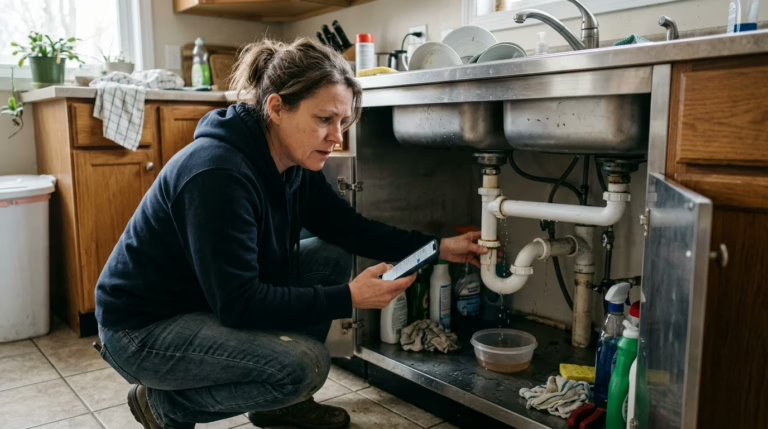
Customers rarely search for services the way businesses describe them internally. They don’t begin with structured, industry-level language. They don’t start by looking up service categories or technical definitions.
They start with problems.
A homeowner doesn’t search for “HVAC maintenance services.” They search for why their furnace is making a loud noise. A driver doesn’t begin with “brake system inspection.” They search for why their car is shaking when they slow down. Someone noticing water where it shouldn’t be isn’t looking for “plumbing diagnostics.” They’re trying to figure out whether the leak they’re seeing is serious.
These are the real entry points. They’re unpolished. Sometimes vague. Often driven by uncertainty. But they reflect the exact moment when someone is trying to make sense of a situation.
When a business consistently shows up at that moment—explaining clearly, without overcomplicating—the perception begins to shift. The business starts to feel helpful, knowledgeable, and familiar before any direct interaction ever takes place.
Why Most Educational Content Misses the Moment
The issue is that many businesses try to educate from a different starting point. Instead of beginning with the problem, they begin with the system.
They write content explaining how air conditioning works, or what types of transmissions exist, or how electrical panels are structured. From an expert’s perspective, these topics are completely logical. They reflect how the business understands its own work.
But the customer isn’t thinking in systems yet. They’re still trying to understand the symptom.
That gap—between how experts think and how customers search—is where a lot of educational content quietly loses its effectiveness. The information itself may be accurate and well-presented, but it doesn’t meet the customer at the moment they’re actually looking for help.
So it gets overlooked. Not because it’s wrong, but because it’s misaligned.
The Gap Between Expertise and Visibility
What makes this especially frustrating is that most businesses already have the answers customers are searching for. They explain these situations every day—in service calls, consultations, and conversations. They know how to break down problems, walk through causes, and guide people toward decisions.
The challenge isn’t knowledge. It’s placement and positioning.
There’s a gap between what the business knows and what the customer is actively searching. If those two things don’t line up, the content never has a chance to do its job.
You’re not lacking expertise. You’re just not consistently placing that expertise in front of the right questions at the right time.
Why “Just Creating Content” Quietly Fails

Even when businesses recognize that education matters, the issue usually isn’t whether they start. It’s how they think about what they’re building.
Most treat content like something that can be “completed.” They create a set of articles or videos around the topics that feel important, and once those are covered, the effort naturally slows down. It begins to feel like there’s nothing left to say.
But customer questions don’t work that way. They don’t arrive once and disappear. They repeat. They evolve slightly. They show up in different forms depending on timing, urgency, and context. The same core concern can surface hundreds of times across different customers, each encountering it as if it were new.
When content is treated as a one-time output, it loses alignment with that ongoing demand.
What’s needed isn’t just coverage—it’s continuity.
At the same time, many businesses rely heavily on passive discovery. They publish something once and assume it will continue reaching the right audience over time. In reality, visibility is not static. Platforms constantly prioritize what is current, active, and engaging in the present moment.
This creates a second layer of friction.
Even well-made content can fade simply because it is no longer recent or consistently reinforced. A helpful explanation from several years ago may still be accurate, but it often doesn’t carry the same weight as something that feels current and actively maintained.
So the problem isn’t just that content gets created and abandoned. It’s that the content system was never designed to stay relevant in the first place.
What It Looks Like to Align With Real Questions
When businesses begin to align their content with real customer questions, the shift is noticeable.
The topics become more specific. More grounded. Less focused on explaining entire systems and more focused on helping people understand what’s happening right now.
Instead of broad overviews, the content starts addressing situations customers actually face—why something fails after a certain number of years, what a particular sound usually indicates, how serious a problem might be, or what decision someone is likely to face next.
These are not abstract topics. They’re extensions of real conversations the business is already having.
The difference is that those conversations are now being captured and shared in a way that others can access.
Where Most Businesses Break Down
Even with the right topics, most businesses still run into the same obstacle: inconsistency.
Without a structure to support ongoing production, content becomes something that happens when there’s time. Topics are chosen on the fly. Filming or writing gets pushed aside when operations get busy. Over time, the effort becomes irregular and difficult to sustain.
This is where many businesses stall—not because they don’t know what to say, but because they don’t have a reliable way to keep saying it.
Answering the right questions once is not the same as being known for answering them.
That recognition comes from repetition and consistency over time.
A Simpler Way to Start
The starting point for improving this is simpler than most people expect.
It begins with paying closer attention to the questions customers are already asking. Not polished versions of those questions, but the exact wording that comes up in real conversations. Questions about urgency, severity, timing, and uncertainty tend to be especially valuable because they reflect genuine concern.
Once those questions are captured, they can be organized into a small number of themes and addressed in a structured way. Content can be created in batches, scheduled consistently, and maintained over time rather than treated as a one-time effort.
The goal is not to produce more content for the sake of volume. It’s to ensure that the content being produced actually aligns with the moments when customers are looking for clarity.
If you’re thinking about how to actually implement that in a way that’s sustainable, we’ve broken down a simple, structured approach in “A Simple Video System Any Local Expert Can Use to Educate Customers.” It walks through how to turn these questions into a repeatable production process without adding constant friction.
The Compounding Effect Most Businesses Never See
When that alignment is combined with consistency, something begins to build.
Each explanation adds another point of familiarity. Each answer becomes another way for a customer to encounter the business before they need it directly. Over time, this creates a body of work that doesn’t just exist—it accumulates.
Customers begin to recognize the business as a source of clear, reliable information. By the time they need help, the decision feels less like a comparison and more like a continuation of something that has already started.
They’re not calling a stranger. They’re reaching out to the business that already helped them understand what was going on.
Explore How We Work
Most expert-led businesses already have the knowledge their customers are searching for. The challenge is rarely expertise—it’s building a system that keeps that expertise visible and relevant over time.
At Moonward Media, we design and operate structured video production systems that help businesses consistently answer the questions their customers are already asking.
If you’re thinking about building a more reliable way to communicate your expertise, you can explore how we work or start a conversation.
Ready for a More Structured Approach to Video?
If you’re looking for a reliable, long-term production system to support your expertise, let’s explore whether we’re the right fit.